
*****
High school sucks. Especially for the undead.
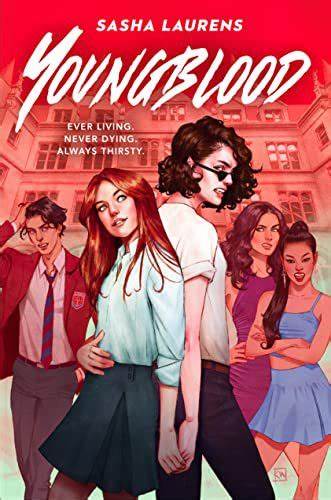
When Kat Finn arrives at Harcote, she’s in uncharted territory. She is suddenly thrust into the alluring world of elite vampires – and her fortune is about to change.
Taylor Sanger is tired of the vampire world’s out-of-touch views, especially as an out-and-proud lesbian. She’s willing to fly under the radar for two more years at Harcote, but Kat’s arrival changes everything.
Kat and Taylor were once best friends. It didn’t end well.
A horrifying discovery means they have to set their differences aside and investigate the deep secrets at Harcote and the conspiracy underpinning all of Vampiredom.
As they investigate, will their old friendship be rekindled into something more?
*****
I’ve always had a soft spot for vampire fiction. I fell in love with the concept when I first watched the Carmilla webseries on Youtube as a teenager (I highly recommend this). My love of vampires is why I picked this book up, and unfortunately, I regretted it. I should have looked at the reviews before I bought it, because I feel like I wasted money on a book I heavily disliked.
Kat Finn is a vampire. This is pretty much the first thing we learn about her. She lives separately to vampires except for her mother. Their finances are strained, which makes feeding difficult for them. The reader soon learns that a horrible disease, CFaD has broken out within humanity and will kill any vampire that drinks from an infected human in a matter of minutes. The enigmatic Victor Castel – founder of CasTech – has developed a blood substitute called hema, which means that vampires can survive without the threat of drinking infected blood.
Kat has dreamed about attending Harcote, a boarding school for the elite vampire youngbloods – vampires who were born after the CFaD outbreak rather than turned. When Kat receives her acceptance email, she is overjoyed, and she is also shocked when she learns that an anonymous benefactor has funded the two years she’ll spend at Harcote.
She soon arrives and integrates herself into the culture of Harcote, making new friends and meeting old friends. Her ex-best friend, Taylor, is also attending Harcote, and the two end up sharing a room. Slowly, they begin to repair their broken relationship, but a death, a conspiracy, and the mysterious Victor Castel seem hellbent on getting in their way.
‘Youngblood’ is 405 pages long (my copy is, at least), and I don’t think it should have been that long. The first 250 pages follows life at the Harcote boarding school and, while the reader gets hints at the main plot during this, the plot doesn’t actually seem to begin until over the halfway mark when a secondary character’s body is found by Taylor. This still does nothing to fully begin the plot. Instead, we spend (in my opinion) far too long learning about the relationship between Kat, and Galen, her boyfriend. I am not against reading books which feature straight people or straight couples, but when a book claims to be sapphic, I have no desire to read about men. Their relationship – to me – was unnecessary, and seems only to have been included to try and make the reader wonder who Kat will choose by the end of the book (it was obviously going to be Taylor).
The pacing problems continue throughout the book, with the plot reaching a head and concluding within the space of maybe 20, 25 pages. For a book of this length, it felt as though it was rushed. We find out with only about forty pages left that CFaD was created in a lab by Victor Castel in an effort to force vampires to live together in Vampiredom and rely on him to feed – he did, after all, create the blood substitute vampires use to sustain themselves. From here on out, things happen quickly, but the plot seems half fleshed out. Kat manages to manipulate Victor into admitting everything and records it on her phone, although the reader learnt only a couple of chapters ago that Victor has been a master manipulator since before Kat was born. How is it possible that this intelligent man could be tricked so easily by a teenager? Things only get worse when Kat and Taylor play his confession to an auditorium filled with vampires who have been directly affected by Castel’s actions. Despite the 400 pages of build up, we never actually get to know what happens to him. The last time we see him, he has his hands pinned behind his back and an army of angry vampires surrounding him, but we don’t see what happens to him. Do they kill him? Do they put him on trial? We don’t know. We don’t even get an explanation from Kat in the last chapter. His fate is an unsatisfying mystery.
The characters are deeply unlikeable, and I doubt I will be reading anything else from this author. She insists on making Kat – a white, straight(ish) girl – the only person who cares about the lack of diversity at the school, and the only one who cares when Taylor’s identity as the only queer student at Harcote is used as an insult. Both of these things could have easily been left out of the book and not changed anything about the plot or the characters. One of the teachers at the school tells Taylor: “I have lived ten times the years you have. Do you really think I cannot comprehend homosexuality?” My only question is this. If that’s the case, then why is queerphobia such a big part of this book? If the vampires are well aware of the existence of homosexuality, then why is this not shown anywhere in the book? Even Kat – who calls herself the Token Ally – freaks out when she first starts to question her sexuality. There is so much queerphobia and bigotry that it made me feel sick.
The worst part is when Kat and Galen are researching CasTech in the school’s underground library. Galen, who is half-Indian, tells Kat how his parents met. His mother is from a Gujarati merchant family, and his father was ‘involved’ in the East India Company. When Kat brings up the colonization of India (which was very white savior of her), Galen says that his parents relationship isn’t as “messed up as it sounds”. He explains that his father didn’t kidnap his mother, and that his father pursued her for years until she agreed to marry him (which is horrific behavior).
This whole paragraph made me (a white person) deeply uncomfortable, and I have read many reviews of South Asian readers saying the same. It was not necessary to the story, and Galen being biracial is never mentioned again. It should not have been put into the book. The author tries to romanticize the colonization of India, and this is not OK. What Britain and the East India Company did to the country and people of India was nothing short of abhorrent, and it should not be spoken of in this way. If you’re going to put POC characters into your books, at least do them the courtesy of speaking the truth and not romanticize the horrors their countries and cultures have been subjected to.
I could go on and on about how much I disliked this book, but this review already feels too long (it’s also enraging me that this was even written or published). To cut it short, I do not recommend this book. There is so much vampire literature out there, and I will do my best to find the books with actual good representation, instead of whatever the hell this book was.
 The Tay Smith Effect